
In order to understand how fermentation works, we need to understand microorganism´s world. Even thought we know them when pasteur discover them, they already existed before that. Nowadays we know that not all microorganism are bad, in fact quite the opposite, some of them are very beneficial for our health. Anyway let´s start from the beginning.
Currently exist three hypothesis that could explain the appearance of the biomolecules that served as the basis for the appearance of the life:
- Synthesis of a reduced atmosphere
It is a well accepted theory that life started 3.800 millions years ago but it is also accepted that there was an ancestor, a quimical compendium which they called prebiotic soup. This soup performs a biosynthesis of molecules to convert them into more complex compounds, until they produce living cells ( Alexander Oparin)
But this was just a theory, they did not have physical evidence. Stanley Miller had an idea: simulate in a lab the conditions of this primitive prebiotic soup. He an his profesor Urey managed to show that more complex molecules could be created from those simple quimical compunds.
- Meteor impact
Some meteors can contain organic carbon in the form of amino acid and nitrogen bases of nucleic acids equivalent molecules. There is scientific evidence that demonstrate that meteorites and comets are responsible for the prebotic soup. These studies confer relevance to the Panspermia theory .
- Synthesis on metal sulphides in cracks of the ocean floor
Biomolecules could have formed in certain seafloor cracks in which the appropriate conditions were given
But those are only theories that yet need to be proven. The most accepted theory is the Alexander Oparin one, the one
The most accepted theory is that of Russian scientist Alexander Oparin, which refers to the union between proteins and lipids that form closed membranous structures. But it was the chance that caused some of these structures to be trapped in organic compounds. This process would be repeated many times, until the first primitive organism was formed.
The first organism was anaerobic and fed on compounds such as CO2, hydrogen sulfide, ammonia, etc.
From this organism and with the help of evolution and millions of years, microorganisms were formed with cytochromes that would later develop chlorophyll. These evolved until they could perform photosynthesis, that is, they fixed atmospheric CO2 in the form of atmospheric carbon and harnessed the sun’s energy to produce O2.
These microorganisms produced so much O2, that the atmosphere became oxidizing. Here begins the journey of the first aerobic organisms since, until then the predominant bacteria were anaerobic.
As we see microorganisms exist since there is life on earth, but they were made known through the French scientist L. Pasteur. It was believed that certain life forms (animal or plant) occurred spontaneously from either organic, inorganic matter or a combination of both, the so-called theory of spontaneous generation.
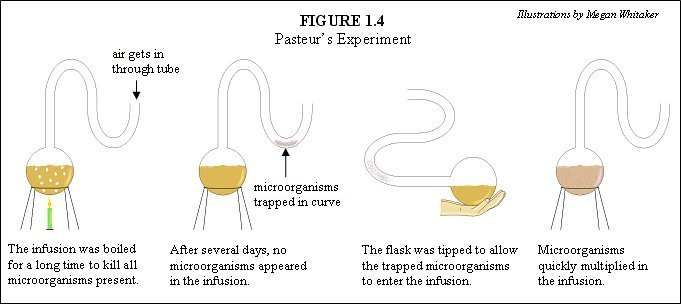
When a piece of meat is left outdoors, it ends up rotting. Under the microscope it can be seen that it contains large amounts of bacteria. Louis Pasteur showed that something so complex could not occur spontaneously. In the air there were structures that closely resembled to those microorganisms found in rotten materials. These microorganisms were constantly deposited on all objects. So if these living organisms that contaminated it were eliminated, it would not rot.
For this experiment he invented a flask with what they called a “gooseneck”. The curvatures of this flask prevented the microorganism from reaching the food and did not rot. If he broke his neck there was rot, which showed that spontaneous generation did not exist and with it that the rot and fermentation of food originate from microorganisms.
From here the world of microorganisms was further investigated and it was shown that some produced diseases. Those times were when the war on bacteria began and lasts until today.
So far we have only talked about microorganisms, which are the ones that help us to ferment food. But when did fermentation appear? When the man appeared on the scene. At the beginning of time we assumed that they discovered the properties of food and the effect of some microorganisms on food, a little by chance, without even having scientific knowledge of what fermentation was. For example in the twentieth century B.C. the Egyptians ate bread with unfermented flour. One day they left it uncooked to celebrate a party and when they went the next day they found a bubbly, spongy and fermented dough. That is why it is believed that they were the first to use yeast.

These ancient fermentation techniques were passed from generation to generation until the food industry came to “make things easier for us.”
We are surrounded by fermented foods on all sides: bread, wine, beer, cheese, yogurt … almost a third of the food is fermented. But some industrial fermented foods have lost their benefits since they are pasteurized to last longer and microorganisms are labile at high temperatures.
For some time now there has been a boom in the so-called “revivalists,” people who are giving manual fermented foods or wild fermentation the importance they deserve, preserving ancestral techniques to get the most benefit from them.
Bibliography:
Ellix Katz, Sandor (2016). the art of fermentation. Editorial: Gaia ediciones
Escalante Urquijo ,Lourdes (2019). “ Introducción a los alimentos fermentados”. revista online “enbuenasmanos”.

 Nutrifanzine